专栏文章
An easier method of polynomial composition: No more transposition theorem is needed!
算法·理论参与者 63已保存评论 65
文章操作
快速查看文章及其快照的属性,并进行相关操作。
- 当前评论
- 65 条
- 当前快照
- 2 份
- 快照标识符
- @mi6114so
- 此快照首次捕获于
- 2025/11/19 21:17 3 个月前
- 此快照最后确认于
- 2025/12/01 21:19 3 个月前
Just some random thoughts arised by a simple problem. But it seems that I'm reinventing wheels once more :(
If there's any mistake in the article, please don't hesitate to point it out in the comment.
Introduction
Yesterday night, my friend asked me a question on polynomials (his profile picture is pixelated in order to prevent privacy issues):
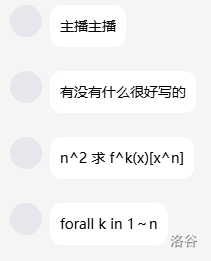
(Translation: Ciallo! Is there any solution for for all in time complexity that is easy to implement?)
And unfortunately I didn't figure out the solution at first. I even considered it as an unsolvable problem:

(Translation: It's actually unsolvable. I guess, isn't it?)
But I suddenly realized that in the latest algorithm for polynomial composition, we have done a similar process working on .
So it might be solvable in ?
Why not give it a try?
Solution
We need to get coefficients for every possible . Let's introduce another term to control the number of in a specific product, and rewrite the coefficient as .
Do you remember how we handled the linear homogeneous recursions using polynomials? We transformed it into an evaluation of a certain coefficient, in the form of a fraction: . We apply Bostan-Mori algorithm on this fraction afterwards.
For the bivariate polynomial with , we could apply a similar technique. Let's say if we are now finding the coefficient . We multiply by on both numerator and denominator to eliminate odd powers of on the denominator, resulting in , where .
After this iteration, we can only conserve about half of the elements depending on the parity of : if is even, we rewrite it as , otherwise we rewrite it as . Now the problem is reduced to a subproblem with same form with the degree of halved. When , the variable is entirely eliminated, and we only need to get using polynomial inversion in time. (Can be done in , but not necessary.)
Consider the time complexity of the algorithm: after each iteration, although the degree of is lifted to twice as before, the degree of is halved. Thus, for every polynomial involved in the calculation, the product of degree for is always , so we can multiply two polynomials within time.
We handled multiplications, because after this number of iterations we will drop into the corner case of . Thus, the whole time complexity is .
Polynomial Composition
Now let us move on to polynomial composition. Suppose we have two polynomials , and a new polynomial is required. (Assume that calculation is done under .) The expression seems to have many similarities with the previous question.
We need to assign a coefficient for each single depending on . We can still maintain the variable , since we know that the term with should be multiplied by .
Thus, we are actually multiplying the whole expression with to let every valid term be of . With the help of this polynomial, the answer could be written as:
The following step is just the same as we have done in the previous part. Moreover, we need to store every coefficient from to , which is slightly different. But an advantage is that the numerator only relates to , instead of both .
Suppose we are handling . Still multiplying by , getting . But the problem is: if we still do casework on the parity of , we will get two branches, leading to wrong time complexity as .
Can we avoid operations on ? Putting into the recursion might be a good choice. Now we have the results for ,and we need to multiply it by .
For the first iteration, as we need coefficient of , we just need to focus on and of , since . Now , and we need in the next iteration. So the number of needed values is depending on . More specifically, we just need to figure out in order to correctly deal with the previous iterations.
As we have said in the previous part, , and , so the time complexity is still per iteration, in total. When , an inverse is needed, which can also be done in .
Thus, polynomial composition under modulo is solved in time complexity.
Code
P10249 (n = 2e5) runtime = 11s on luogu
CPP#include <bits/stdc++.h>
using ll = long long;
using ld = long double;
using ull = unsigned long long;
using namespace std;
template <class T>
using Ve = vector<T>;
#define ALL(v) (v).begin(), (v).end()
#define pii pair<ll, ll>
#define rep(i, a, b) for(int i = (a); i <= (b); ++i)
#define per(i, a, b) for(int i = (a); i >= (b); --i)
#define pb push_back
bool Mbe;
ll read() {
ll x = 0, f = 1; char ch = getchar();
while(ch < '0' || ch > '9') {if(ch == '-') f = -1; ch = getchar();}
while(ch >= '0' && ch <= '9') x = x * 10 + ch - '0', ch = getchar();
return x * f;
}
void write(ll x) {
if(x < 0) putchar('-'), x = -x;
if(x > 9) write(x / 10);
putchar(x % 10 + '0');
}
const ll N = 2e5 + 9;
const ll Mod = 998244353, G = 3, iG = (Mod + 1) / 3;
struct poly {
Ve<int> a;
int size() const {return a.size();}
void resize(int n) {a.resize(n);}
int operator[] (int n) const {
assert(0 <= n && n < (int)a.size());
return a[n];
}
int &operator[] (int n) {
assert(0 <= n && n < (int)a.size());
return a[n];
}
};
int rev[N << 5], tw[N << 5];
int Init(int n) {
int p = 1, c = 0;
while(p <= n) p <<= 1, ++c;
rev[0] = 0;
rep(i, 1, p - 1) rev[i] = (rev[i >> 1] >> 1) | ((i & 1) << (c - 1));
return p;
}
int pw(int x, int p) {
int res = 1;
while(p) {
if(p & 1) res = 1ll * res * x % Mod;
x = 1ll * x * x % Mod, p >>= 1;
}
return res;
}
int Add(int x, int y) {
return ((x += y) >= Mod) ? (x - Mod) : x;
}
int Sub(int x, int y) {
return ((x -= y) < 0) ? (x + Mod) : x;
}
void NTT(poly &a, int n, int sgn) {
rep(i, 0, n - 1) {
if(i < rev[i]) swap(a[i], a[rev[i]]);
}
for(int i = 1; i < n; i <<= 1) {
int wn = pw((sgn == 1 ? G : iG), (Mod - 1) / (i << 1));
tw[0] = 1;
rep(j, 1, i - 1) tw[j] = 1ll * tw[j - 1] * wn % Mod;
for(int j = 0; j < n; j += (i << 1)) {
rep(k, 0, i - 1) {
int x = a[j + k], y = 1ll * a[j + k + i] * tw[k] % Mod;
a[j + k] = Add(x, y), a[j + k + i] = Sub(x, y);
}
}
}
if(~sgn) return ;
int iv = pw(n, Mod - 2);
rep(i, 0, n - 1) a[i] = 1ll * a[i] * iv % Mod;
return ;
}
poly operator * (const poly &a, const poly &b) {
ll n = a.size(), m = b.size();
ll p = Init(n + m - 1);
poly f = a, g = b; f.resize(p), g.resize(p);
NTT(f, p, 1), NTT(g, p, 1);
rep(i, 0, p - 1) f[i] = 1ll * f[i] * g[i] % Mod;
NTT(f, p, -1), f.resize(n + m - 1);
return f;
}
poly Inv(poly h, int n){
if(n == 1){
poly f;
f.resize(1), f[0] = pw(h[0], Mod - 2);
return f;
}
int n0 = (n + 1) >> 1;
poly h0 = h; h0.resize(n0);
poly f0 = Inv(h0, n0); f0.resize(n);
int len = Init(n << 1);
poly _f0 = f0; _f0.resize(len), h.resize(len);
NTT(_f0, len, 1), NTT(h, len, 1);
rep(i, 0, len - 1) _f0[i] = 1ll * _f0[i] * _f0[i] % Mod * h[i] % Mod;
NTT(_f0, len, -1), _f0.resize(n);
rep(i, 0, n - 1) f0[i] = (f0[i] * 2ll - _f0[i] + Mod) % Mod;
return f0;
}
Ve<poly> work(const poly &P, const Ve<poly> &Q, int n) {
int maxy = (int)Q.size() - 1;
if(!n) {
poly Q0; Q0.resize(maxy + 1);
rep(i, 0, maxy) Q0[i] = Q[i][0];
Q0 = Inv(Q0, maxy + 1);
int lenP = P.size(); poly R = P;
reverse(ALL(R.a));
R = R * Q0;
poly res; res.resize(maxy);
rep(i, 0, (int)R.size() - 1) {
int cy = i - (lenP - 1);
if(cy <= 0 && cy >= -maxy + 1) res[-cy] = R[i];
}
Ve<poly> ret; ret.resize(maxy);
rep(i, 0, maxy - 1) ret[i].resize(1), ret[i][0] = res[i];
return ret;
}
int n2 = (n << 1) | 1;
int len = Init(n2 * max(maxy + 1, maxy * 2) + n2 * (maxy + 1));
poly pos, neg; pos.resize(len), neg.resize(len);
rep(i, 0, maxy) {
rep(j, 0, (int)Q[i].size() - 1) {
int pwr = i * n2 + j;
pos[pwr] = Q[i][j];
if(j & 1) neg[pwr] = (Mod - Q[i][j]);
else neg[pwr] = Q[i][j];
}
}
NTT(neg, len, 1);
NTT(pos, len, 1);
rep(i, 0, len - 1) pos[i] = 1ll * pos[i] * neg[i] % Mod;
NTT(pos, len, -1);
Ve<poly> Q0; Q0.resize(maxy * 2 + 1);
rep(i, 0, maxy * 2) Q0[i].resize((n >> 1) + 1);
rep(i, 0, (int)pos.size() - 1) {
int cy = i / n2, cx = i - cy * n2;
if(cx & 1) continue;
if(cx > n || cy > maxy * 2) continue;
Q0[cy][cx >> 1] = pos[i];
}
Ve<poly> ret0 = work(P, Q0, n >> 1);
int len0 = ret0.size();
reverse(ALL(ret0));
Init(len - 1);
pos.a.clear(), pos.resize(len);
rep(i, 0, len0 - 1) {
rep(j, 0, (int)ret0[i].size() - 1) {
int pwr = i * n2 + j * 2;
pos[pwr] = ret0[i][j];
}
}
NTT(pos, len, 1);
rep(i, 0, len - 1) pos[i] = 1ll * pos[i] * neg[i] % Mod;
NTT(pos, len, -1);
Ve<poly> ret; ret.resize(maxy);
rep(i, 0, maxy - 1) ret[i].resize(n + 1);
rep(i, 0, (int)pos.size() - 1) {
int cy = i / n2, cx = i - cy * n2;
cy -= (len0 - 1);
if(cy <= 0 && cy >= -maxy + 1) {
if(cx <= n) ret[-cy][cx] = pos[i];
}
}
return ret;
}
int n, m;
poly f, g;
bool Med;
int main() {
cerr << fabs(&Med - &Mbe) / 1048576.0 << "MB\n";
n = read(), m = read();
f.resize(n + 1), g.resize(m + 1);
rep(i, 0, n) f[i] = read();
rep(i, 0, m) g[i] = Mod - read();
poly con; con.resize(1), con[0] = 1;
Ve<poly> h = work(f, {con, g}, n);
assert(h.size() == 1);
rep(i, 0, n) write(h[0][i]), putchar(' ');
putchar('\n');
cerr << "\n" << clock() * 1.0 / CLOCKS_PER_SEC * 1000 << "ms\n";
return 0;
}
References:
-
Yasunori Kinoshita, Baitian Li: Power Series Composition in Near-Linear Time.
-
alpha1022: 多项式不存在了:多项式复合(逆)的 O(nlog^2n) 做法.
 多项式不存在了:多项式复合(逆)的 O(nlog^2n) 做法
相关推荐
评论
共 65 条评论,欢迎与作者交流。
正在加载评论...