专栏文章
线段树的进阶用法
算法·理论参与者 7已保存评论 8
文章操作
快速查看文章及其快照的属性,并进行相关操作。
- 当前评论
- 8 条
- 当前快照
- 1 份
- 快照标识符
- @mipvfqcs
- 此快照首次捕获于
- 2025/12/03 18:35 3 个月前
- 此快照最后确认于
- 2025/12/03 18:35 3 个月前
前言
线段树是在 OI 中受到广泛应用的一种数据结构,其变种多,难度较大。作者发现自己对线段树的理解也很糖,故作此文以总结。
作者自己水平太菜,对许多知识点理解不深,讲得也比较肤浅,各位大佬见谅。
各个知识点的 OI-Wiki 链接在题单中有。
对难度 & 实用程度的说明:均 (个人向,仅供参考),假设标准懒标记线段树(即线段树 1 模板题)的难度为 。
保证知识点经过拓扑排序。
下文默认读者已经掌握线段树基础及懒标记的使用。
权值线段树
评价
- 难度:
- 实用程度:
介绍
比较简单的理解:把线段树当桶用。
用线段树来维护某个值的覆盖次数。由于可以实现区修区查,效率较高。
常用于一些简单 DP 的优化(之前 ABC 应该出过几道权值线段树优化 DP,忘记编号了)。
权值线段树是主席树的基础,需要牢固掌握。
例题
P1908 逆序对
首先注意到只有数字的大小关系重要,具体数字不重要,因此将数据离散化方便权值线段树处理。
从前往后把数据加入线段树。对于第 个数,前面的数对它产生的贡献为 ,那么 的范围为 (因为将数据离散化过)。使用权值线段树快速查即可,复杂度 。
这个题用权值树状数组也行,不过更多题只能用线段树做。
代码是我远古时期写的,过于丑陋,不放了。
线段树二分
评价
- 难度:
- 实用程度:
介绍
一句话:把外部二分、内部线段树改为在线段树上二分。
如果你在外面做一次二分,在二分的
check() 中使用线段树查询,则会导致两只 的复杂度。而如果选择在线段树查询过程中通过记录信息,决策向左子树还是右子树递归,则可以砍掉一只 。这在许多题中是非常重要的。例题
P5579 Siano
观察此题的性质:长得快得一定长得高,不管有没有被割掉,在将生长速度排序以后,每一次割掉的一定是一个后缀区间。
于是可以用线段树维护了:为了找到生长速度最小的被割的点,在线段树上额外记录包含区间的 值,在递归时决定往左子树走还是右子树走。复杂度 。
代码:
CPP// NOTE: "[EDIT]" means you should edit this part by yourself
#include <bits/stdc++.h>
// [EDIT] please enable this line if there are many tests
//#define MULTITEST
using namespace std;
// [EDIT] if you want to copy some templates, please paste them here
typedef long long ll;
#define int ll
#define rep1(i,x,y) for (int i = (x);i <= (y);i++)
#define rep2(i,x,y) for (int i = (x);i >= (y);i--)
#define rep3(i,x,y,z) for (int i = (x);i <= (y);i += (z))
#define rep4(i,x,y,z) for (int i = (x);i >= (y);i -= (z))
#define cl(a) memset(a,0,sizeof(a))
// [EDIT] define some constants here
const int N = 5e5 + 10;
// [EDIT] define some variables, arrays, etc here
int n,q,d,b;
int a[N],sum[N];
struct node
{
int height;
int tim;
int sum;
int mx;
} t[N << 2];
inline int ls(int p) { return p << 1; }
inline int rs(int p) { return p << 1 | 1; }
inline void push_up(int p)
{
t[p].sum = t[ls(p)].sum + t[rs(p)].sum;
t[p].mx = t[rs(p)].mx;
}
inline void cut(int p,int l,int r,int v)
{
t[p].height = v;
t[p].tim = 0;
t[p].sum = (r - l + 1) * v;
t[p].mx = v;
}
inline void grow(int p,int l,int r,int v)
{
t[p].tim += v;
t[p].sum += (sum[r] - sum[l - 1]) * v;
t[p].mx += a[r] * v;
}
void push_down(int p,int l,int r)
{
int mid = (l + r) >> 1;
if (t[p].height != -1)
{
cut(ls(p),l,mid,t[p].height);
cut(rs(p),mid + 1,r,t[p].height);
t[p].height = -1;
}
if (t[p].tim > 0)
{
grow(ls(p),l,mid,t[p].tim);
grow(rs(p),mid + 1,r,t[p].tim);
t[p].tim = 0;
}
}
void build(int p,int l,int r)
{
t[p].height = -1;
if (l == r)
return;
int mid = (l + r) >> 1;
build(ls(p),l,mid);
build(rs(p),mid + 1,r);
}
int modify(int p,int l,int r,int L,int R,int v)
{
if (L <= l && r <= R)
{
int tmp = t[p].sum;
cut(p,l,r,v);
return tmp - t[p].sum;
}
int ans = 0;
int mid = (l + r) >> 1;
push_down(p,l,r);
if (L <= mid)
ans += modify(ls(p),l,mid,L,R,v);
if (R > mid)
ans += modify(rs(p),mid + 1,r,L,R,v);
push_up(p);
return ans;
}
int query(int p,int l,int r,int v)
{
if (l == r)
{
if (t[p].sum >= v)
return l;
else
return n + 1;
}
int mid = (l + r) >> 1;
push_down(p,l,r);
if (t[ls(p)].mx >= v)
return query(ls(p),l,mid,v);
else
return query(rs(p),mid + 1,r,v);
}
// [EDIT] a function to solve the problem
void solve()
{
//input
cin >> n >> q;
rep1(i,1,n)
cin >> a[i];
//solve
sort(a + 1,a + n + 1);
rep1(i,1,n)
sum[i] = sum[i - 1] + a[i];
build(1,1,n);
int pre = 0;
while (q--)
{
cin >> d >> b;
grow(1,1,n,d - pre);
pre = d;
cout << modify(1,1,n,query(1,1,n,b),n,b) << '\n';
}
//output
//clear
}
signed main()
{
ios::sync_with_stdio(false);
cin.tie(0);
cout.tie(0);
int t;
#ifdef MULTITEST
cin >> t;
#else
t = 1;
#endif
while (t--)
solve();
}
P11833 [省选联考 2025] 推箱子
新鲜出炉的省选题,在我的另一篇学习笔记中也有提及。
 另一篇学习笔记
结论:按照 从小到大贪心处理,中间遇上箱子就推着一起走。因为 均单调递增可以证明。
注意到推着一起走相当于把所有箱子都推到终点(相邻两个箱子之前相差 ),是推平成等差数列操作。
这里有一个常见 trick:令 ,则推平成等差数列转化为推平成一段相同的数。
在那篇笔记中我采用了珂朵莉树实现,但线段树显然也是可以的。记录一个区间的 线段树二分即可。
代码:
CPP// NOTE: "[EDIT]" means you should edit this part by yourself
#include <bits/stdc++.h>
// [EDIT] please enable this line if there are many tests
#define MULTITEST
using namespace std;
// [EDIT] if you want to copy some templates, please paste them here
typedef long long ll;
#define int ll
#define rep1(i,x,y) for (int i = (x);i <= (y);i++)
#define rep2(i,x,y) for (int i = (x);i >= (y);i--)
#define rep3(i,x,y,z) for (int i = (x);i <= (y);i += (z))
#define rep4(i,x,y,z) for (int i = (x);i >= (y);i -= (z))
#define cl(a) memset(a,0,sizeof(a))
// [EDIT] define some constants here
const int N = 2e5 + 10;
// [EDIT] define some variables, arrays, etc here
int n;
struct xxx
{
int a;
int b;
int t;
int id;
bool operator<(const xxx& xx) { return t < xx.t; }
} a[N];
struct segtree
{
struct node
{
int l;
int r;
int sum;
int mx;
int mn;
int lazy;
} t[N << 2];
inline int ls(int p) { return p << 1; }
inline int rs(int p) { return p << 1 | 1; }
inline void push_up(int p)
{
t[p].sum = t[ls(p)].sum + t[rs(p)].sum;
t[p].mx = max(t[ls(p)].mx,t[rs(p)].mx);
t[p].mn = min(t[ls(p)].mn,t[rs(p)].mn);
}
inline void modifyy(int p,int k,int len)
{
t[p].mx = k;
t[p].mn = k;
t[p].lazy = k;
t[p].sum = k * len;
}
void push_down(int p)
{
if (t[p].lazy != -1)
{
int mid = (t[p].l + t[p].r) >> 1;
modifyy(ls(p),t[p].lazy,mid - t[p].l + 1);
modifyy(rs(p),t[p].lazy,t[p].r - mid);
t[p].lazy = -1;
}
}
void clear() { cl(t); }
void build(int p,int l,int r)
{
t[p].l = l;
t[p].r = r;
t[p].lazy = -1;
if (l == r)
{
t[p].sum = a[l].a;
t[p].mx = a[l].a;
t[p].mn = a[l].a;
return;
}
int mid = (l + r) >> 1;
build(ls(p),l,mid);
build(rs(p),mid + 1,r);
push_up(p);
}
void modify(int p,int l,int r,int k)
{
if (l <= t[p].l && t[p].r <= r)
{
modifyy(p,k,t[p].r - t[p].l + 1);
return;
}
int mid = (t[p].l + t[p].r) >> 1;
push_down(p);
if (l <= mid)
modify(ls(p),l,r,k);
if (r > mid)
modify(rs(p),l,r,k);
push_up(p);
}
int query1(int p,int l,int r)
{
if (l <= t[p].l && t[p].r <= r)
return t[p].sum;
int mid = (t[p].l + t[p].r) >> 1;
push_down(p);
int ans = 0;
if (l <= mid)
ans += query1(ls(p),l,r);
if (r > mid)
ans += query1(rs(p),l,r);
return ans;
}
int query2(int p,int k)
{
if (t[p].l == t[p].r)
return t[p].l;
int mid = (t[p].l + t[p].r) >> 1;
push_down(p);
if (t[rs(p)].mn <= k)
return query2(rs(p),k);
else
return query2(ls(p),k);
}
int query3(int p,int k)
{
if (t[p].l == t[p].r)
return t[p].l;
int mid = (t[p].l + t[p].r) >> 1;
push_down(p);
if (t[ls(p)].mx >= k)
return query3(ls(p),k);
else
return query3(rs(p),k);
}
} t;
// [EDIT] a function to solve the problem
void solve()
{
//input
cin >> n;
rep1(i,1,n)
{
a[i].id = i;
cin >> a[i].a >> a[i].b >> a[i].t;
a[i].a -= i;
a[i].b -= i;
}
//solve
t.clear();
t.build(1,1,n);
sort(a + 1,a + n + 1);
int now = 0;
rep1(i,1,n)
if (a[i].a < a[i].b)
{
int pos = t.query2(1,a[i].b);
now += a[i].b * (pos - a[i].id + 1) - t.query1(1,a[i].id,pos);
if (now > a[i].t)
{
cout << "No\n";
return;
}
t.modify(1,a[i].id,pos,a[i].b);
}
else
{
int pos = t.query3(1,a[i].b);
now += t.query1(1,pos,a[i].id) - a[i].b * (a[i].id - pos + 1);
if (now > a[i].t)
{
cout << "No\n";
return;
}
t.modify(1,pos,a[i].id,a[i].b);
}
//output
cout << "Yes\n";
//clear
}
signed main()
{
ios::sync_with_stdio(false);
cin.tie(0);
cout.tie(0);
int t;
#ifdef MULTITEST
cin >> t >> t;
#else
t = 1;
#endif
while (t--)
solve();
}
动态开点线段树
评价
- 难度:
- 实用程度:(如果不需要用可持久化线段树之类高级东西则几乎为 ,否则必须用)
介绍
主要是可持久化线段树等的前置知识。
普通线段树需要长为 的数组, 的左右儿子为 。而动态开点线段树只在必要的时候创建节点,左右儿子改为用 动态记录。其余写法跟普通线段树没区别。
具体实现参见 OI-Wiki。
例题
动态开点线段树是一种优化技巧,不是特定算法,因此没有例题。
可持久化线段树
评价
- 难度:
- 实用程度:
介绍
在许多问题中,我们在对线段树进行修改的同时,还要支持查询历史版本。
最暴力的想法是每次开一颗线段树,但这空间显然是会爆掉的。
观察线段树结构,发现一次修改所涉及的节点最多只有 个,见下图(由于作者太懒,取自 OI-Wiki):
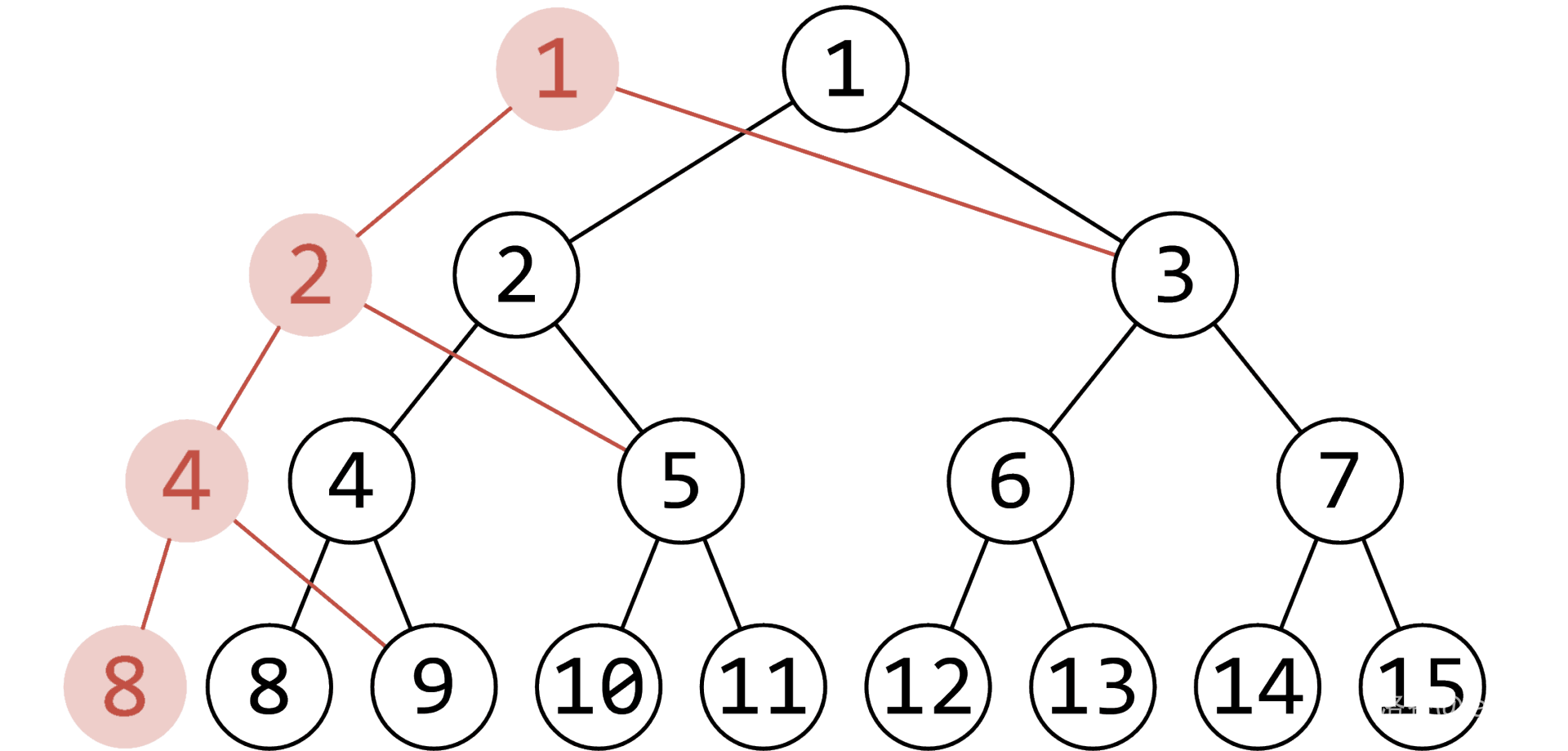
在上面这个例子中,我们对 号节点进行修改,只会更改红色节点。每层只有一个,而树高为 ,因此只涉及到 个节点。
因此我们只要在每次修改时新开一棵线段树的一小部分即可。
例题
SP3946 MKTHNUM - K-th Number
非常经典的主席树题。
首先澄清一下许多人的误解,主席树是权值版本的可持久化线段树,并不等同于可持久化线段树,更准确地说是可持久化线段树的真子集。
考虑从前往后每次加入序列中的下一个元素,并生成一棵新的权值线段树。
运用前缀和的思想,区间 的答案就是用第 个版本的线段树减去第 个版本的线段树。因此主席树可以高效实现。
代码:
CPP// NOTE: "[EDIT]" means you should edit this part by yourself
#include <bits/stdc++.h>
// [EDIT] please enable this line if there are many tests
//#define MULTITEST
using namespace std;
// [EDIT] if you want to copy some templates, please paste them here
typedef long long ll;
#define rep1(i,x,y) for (int i = (x);i <= (y);i++)
#define rep2(i,x,y) for (int i = (x);i >= (y);i--)
#define rep3(i,x,y,z) for (int i = (x);i <= (y);i += (z))
#define rep4(i,x,y,z) for (int i = (x);i >= (y);i -= (z))
#define cl(a) memset(a,0,sizeof(a))
// [EDIT] define some constants here
const int N = 1e5 + 10;
// [EDIT] define some variables, arrays, etc here
int n,q,ii,jj,kk,cnt;
int a[N],b[N];
struct node
{
int sum;
int root;
int ls;
int rs;
} t[N << 5];
void build(int& k,int l,int r)
{
k = ++cnt;
if (l == r)
return;
int mid = (l + r) >> 1;
build(t[k].ls,l,mid);
build(t[k].rs,mid + 1,r);
}
int modify(int p,int l,int r,int x)
{
int xx = ++cnt;
t[xx].ls = t[p].ls;
t[xx].rs = t[p].rs;
t[xx].sum = t[p].sum + 1;
if (l == r)
return xx;
int mid = (l + r) >> 1;
if (x <= mid)
t[xx].ls = modify(t[xx].ls,l,mid,x);
else
t[xx].rs = modify(t[xx].rs,mid + 1,r,x);
return xx;
}
int query(int u,int v,int l,int r,int k)
{
int mid = (l + r) >> 1;
int x = t[t[v].ls].sum - t[t[u].ls].sum;
if (l == r)
return l;
if (x >= k)
return query(t[u].ls,t[v].ls,l,mid,k);
else
return query(t[u].rs,t[v].rs,mid + 1,r,k - x);
}
// [EDIT] a function to solve the problem
void solve()
{
//input
cin >> n >> q;
rep1(i,1,n)
{
cin >> a[i];
b[i] = a[i];
}
//solve
sort(b + 1,b + n + 1);
int len = unique(b + 1,b + n + 1) - b - 1;
build(t[0].root,1,len);
rep1(i,1,n)
t[i].root = modify(t[i - 1].root,1,len,lower_bound(b + 1,b + len + 1,a[i]) - b);
while (q--)
{
cin >> ii >> jj >> kk;
cout << b[query(t[ii - 1].root,t[jj].root,1,len,kk)] << '\n';
}
//output
//clear
}
int main()
{
ios::sync_with_stdio(false);
cin.tie(0);
cout.tie(0);
int t;
#ifdef MULTITEST
cin >> t;
#else
t = 1;
#endif
while (t--)
solve();
}
P3402 可持久化并查集
可持久化并查集是基于可持久化线段树实现的。
把普通并查集的
fa 和 dep 数组扔到可持久化线段树上维护。在可持久化并查集中路径压缩会被卡。只能用启发式合并。
代码:
CPP// NOTE: "[EDIT]" means you should edit this part by yourself
#include <bits/stdc++.h>
// [EDIT] please enable this line if there are many tests
//#define MULTITEST
using namespace std;
// [EDIT] if you want to copy some templates, please paste them here
typedef long long ll;
#define rep1(i,x,y) for (int i = (x);i <= (y);i++)
#define rep2(i,x,y) for (int i = (x);i >= (y);i--)
#define rep3(i,x,y,z) for (int i = (x);i <= (y);i += (z))
#define rep4(i,x,y,z) for (int i = (x);i >= (y);i -= (z))
#define cl(a) memset(a,0,sizeof(a))
// [EDIT] define some constants here
const int N = 3e5 + 10;
// [EDIT] define some variables, arrays, etc here
int n,m,now,to,cnt,op,aa,bb;
int root[N];
struct node
{
int ls;
int rs;
int fa;
int dep;
} t[N * 20];
int build(int l,int r)
{
int tt = ++cnt;
if (l == r)
{
t[tt].fa = l;
return tt;
}
int mid = (l + r) >> 1;
t[tt].ls = build(l,mid);
t[tt].rs = build(mid + 1,r);
return tt;
}
int query(int nw,int l,int r,int x)
{
if (l == r)
return nw;
int mid = (l + r) >> 1;
if (x <= mid)
return query(t[nw].ls,l,mid,x);
else
return query(t[nw].rs,mid + 1,r,x);
}
int find(int nw,int a)
{
int ff = query(root[nw],1,n,a);
if (t[ff].fa == a)
return ff;
return find(nw,t[ff].fa);
}
int newnode(int nw)
{
int tt = ++cnt;
t[tt] = t[nw];
return tt;
}
int hb(int nw,int l,int r,int x,int f)
{
int tt = newnode(nw);
if (l == r)
{
t[tt].fa = f;
return tt;
}
int mid = (l + r) >> 1;
if (x <= mid)
t[tt].ls = hb(t[nw].ls,l,mid,x,f);
else
t[tt].rs = hb(t[nw].rs,mid + 1,r,x,f);
return tt;
}
int add(int nw,int l,int r,int x)
{
int tt = newnode(nw);
if (l == r)
{
t[tt].dep++;
return tt;
}
int mid = (l + r) >> 1;
if (x <= mid)
t[tt].ls = add(t[nw].ls,l,mid,x);
else
t[tt].rs = add(t[nw].rs,mid + 1,r,x);
return tt;
}
void merge(int nw,int a,int b)
{
root[nw] = root[nw - 1];
a = find(nw,a);
b = find(nw,b);
if (t[a].fa != t[b].fa)
{
if (t[a].dep > t[b].dep)
swap(a,b);
root[nw] = hb(root[nw - 1],1,n,t[a].fa,t[b].fa);
if (t[a].dep == t[b].dep)
root[nw] = add(root[nw],1,n,t[b].fa);
}
}
bool check(int nw,int a,int b)
{
a = find(nw,a);
b = find(nw,b);
return t[a].fa == t[b].fa;
}
// [EDIT] a function to solve the problem
void solve()
{
//input
cin >> n >> m;
//solve
root[0] = build(1,n);
rep1(i,1,m)
{
cin >> op >> aa;
switch (op)
{
case 1:
cin >> bb;
merge(i,aa,bb);
break;
case 2:
root[i] = root[aa];
break;
case 3:
cin >> bb;
cout << check(i - 1,aa,bb) << '\n';
root[i] = root[i - 1];
break;
}
}
//output
//clear
}
int main()
{
ios::sync_with_stdio(false);
cin.tie(0);
cout.tie(0);
int t;
#ifdef MULTITEST
cin >> t;
#else
t = 1;
#endif
while (t--)
solve();
}
扫描线
评价
- 难度:
- 实用程度:
介绍
扫描线是数据结构与几何结合的一个经典案例(?,但实用程度不高就是了。
它的核心思想是维护一个从下到上(其他方向也没关系)扫的扫描线,分析图形被截得的线段长。
具体见下方模板题例题的解析。
例题
P5490 【模板】扫描线 & 矩形面积并
都是矩形的条件将这题简化了很多。运用微积分求面积的思想,只要对于每个 ,将其截得长度累加即可。
每次扫描线在遇到横边时停下来。为了快速计算,将图形上横边赋值为 ,下横边权值为 。这一点需要仔细体会。可以简单地理解为上下相减才能求出面积。
最后将所有点 坐标离散化缩小范围。用线段树,每次向上扫描后更新就行了。
代码:
CPP#include <bits/stdc++.h>
#define int long long
#define y1 JiNianCSPJ_2024T2BaWoChuangSiDeTiMuWoYiHouZaiYeBuHuiFanZheGeCuoLeQAQ
#define rep1(i,a,b) for (int i = (a);i <= (b);i++)
using namespace std;
const int N = 2e6 + 10;
int n,x1,y1,x2,y2,ans;
int x[N];
struct xxx
{
int l;
int r;
int h;
int mark;
} line[N];
struct node
{
int l;
int r;
int sum;
int len;
} t[N];
bool cmp(const xxx& xx,const xxx& yy) { return xx.h < yy.h; }
inline int ls(int p) { return p << 1; }
inline int rs(int p) { return p << 1 | 1; }
void build(int p,int l,int r)
{
t[p].l = l;
t[p].r = r;
if (l == r)
return;
int mid = (l + r) >> 1;
build(ls(p),l,mid);
build(rs(p),mid + 1,r);
}
inline void push_up(int p)
{
if (t[p].sum != 0)
t[p].len = x[t[p].r + 1] - x[t[p].l];
else
t[p].len = t[ls(p)].len + t[rs(p)].len;
}
void modify(int p,int l,int r,int k)
{
if (x[t[p].r + 1] <= l || r <= x[t[p].l])
return;
if (l <= x[t[p].l] && x[t[p].r + 1] <= r)
t[p].sum += k;
else
{
modify(ls(p),l,r,k);
modify(rs(p),l,r,k);
}
push_up(p);
}
signed main()
{
cin >> n;
rep1(i,1,n)
{
cin >> x1 >> y1 >> x2 >> y2;
x[2 * i - 1] = x1;
x[2 * i] = x2;
line[2 * i - 1] = {x1,x2,y1,1};
line[2 * i] = {x1,x2,y2,-1};
}
n *= 2;
sort(line + 1,line + n + 1,cmp);
sort(x + 1,x + n + 1);
int len = unique(x + 1,x + n + 1) - x - 1;
build(1,1,len - 1);
rep1(i,1,n - 1)
{
modify(1,line[i].l,line[i].r,line[i].mark);
ans += t[1].len * (line[i + 1].h - line[i].h);
}
cout << ans;
}
AT_abc346_g [ABC346G] Alone
枚举要求的区间中的唯一整数。对于元素 ,如果它在 区间中只出现一次,则 都不与 相同。每个元素的 可以用
map 求。则方案数为 。但这样会重复统计。观察到就是求多个左下角 ,右上角 的矩形面积并。扫描线即可。
代码:
CPP#include <bits/stdc++.h>
#define int long long
#define y1 JiNianCSPJ_2024T2BaWoChuangSiDeTiMuWoYiHouZaiYeBuHuiFanZheGeCuoLeQAQ
#define rep1(i,a,b) for (int i = (a);i <= (b);i++)
#define rep2(i,a,b) for (int i = (a);i >= (b);i--)
using namespace std;
const int N = 2e6 + 10;
int n,x1,y1,x2,y2,ans;
int x[N],a[N],p[N],l[N],r[N];
struct xxx
{
int l;
int r;
int h;
int mark;
} line[N];
struct node
{
int l;
int r;
int sum;
int len;
} t[N];
bool cmp(const xxx& xx,const xxx& yy) { return xx.h < yy.h; }
inline int ls(int p) { return p << 1; }
inline int rs(int p) { return p << 1 | 1; }
void build(int p,int l,int r)
{
t[p].l = l;
t[p].r = r;
if (l == r)
return;
int mid = (l + r) >> 1;
build(ls(p),l,mid);
build(rs(p),mid + 1,r);
}
inline void push_up(int p)
{
if (t[p].sum != 0)
t[p].len = x[t[p].r + 1] - x[t[p].l];
else
t[p].len = t[ls(p)].len + t[rs(p)].len;
}
void modify(int p,int l,int r,int k)
{
if (x[t[p].r + 1] <= l || r <= x[t[p].l])
return;
if (l <= x[t[p].l] && x[t[p].r + 1] <= r)
t[p].sum += k;
else
{
modify(ls(p),l,r,k);
modify(rs(p),l,r,k);
}
push_up(p);
}
signed main()
{
cin >> n;
rep1(i,1,n)
cin >> a[i];
rep1(i,1,n)
{
l[i] = p[a[i]];
p[a[i]] = i;
}
rep1(i,1,n)
p[i] = n + 1;
rep2(i,n,1)
{
r[i] = p[a[i]];
p[a[i]] = i;
}
rep1(i,1,n)
{
x1 = l[i];
y1 = i;
x2 = i;
y2 = r[i];
x[2 * i - 1] = x1;
x[2 * i] = x2;
line[2 * i - 1] = {x1,x2,y1,1};
line[2 * i] = {x1,x2,y2,-1};
}
n *= 2;
sort(line + 1,line + n + 1,cmp);
sort(x + 1,x + n + 1);
int len = unique(x + 1,x + n + 1) - x - 1;
build(1,1,len - 1);
rep1(i,1,n - 1)
{
modify(1,line[i].l,line[i].r,line[i].mark);
ans += t[1].len * (line[i + 1].h - line[i].h);
}
cout << ans;
}
线段树分治
评价
- 难度:
- 实用程度:
介绍
线段树分治适用于离线解决“某元素(可能是边)在某时刻出现、某时消失”的问题。
核心思想是离线后在时间轴上建线段树。对于每个操作,相当于在线段树上进行区间修改/查询。
其最重要的作用是,辅助一些撤销操作复杂度不优秀的数据结构使用。
例题
P5787 二分图 /【模板】线段树分治
引理:一个图是二分图等价于该图不存在奇环。读者自证不难。
奇环就可以用扩展域并查集快速维护了。黑白染色, 分别表示两种颜色,相撞了就是奇环。
然后线段树分治搞搞即可。为了支持回溯操作,要用可撤销并查集。
代码:
CPP// NOTE: "[EDIT]" means you should edit this part by yourself
#include <bits/stdc++.h>
// [EDIT] please enable this line if there are many tests
//#define MULTITEST
using namespace std;
// [EDIT] if you want to copy some templates, please paste them here
typedef long long ll;
typedef pair<int,int> pii;
#define rep1(i,x,y) for (int i = (x);i <= (y);i++)
#define rep2(i,x,y) for (int i = (x);i >= (y);i--)
#define rep3(i,x,y,z) for (int i = (x);i <= (y);i += (z))
#define rep4(i,x,y,z) for (int i = (x);i >= (y);i -= (z))
#define cl(a) memset(a,0,sizeof(a))
// [EDIT] define some constants here
const int N = 2e5 + 10;
const int M = 1e5 + 3;
// [EDIT] define some variables, arrays, etc here
int n,m,k,l,r;
int fa[N],d[N],u[N],v[N];
struct node
{
int l;
int r;
vector<int> v;
} t[N << 2];
stack<pii> st;
inline int ls(int p) { return p << 1; }
inline int rs(int p) { return p << 1 | 1; }
void build(int p,int l,int r)
{
t[p].l = l;
t[p].r = r;
if (l == r)
return;
int mid = (l + r) >> 1;
build(ls(p),l,mid);
build(rs(p),mid + 1,r);
}
void insert(int p,int l,int r,int x)
{
if (l <= t[p].l && t[p].r <= r)
{
t[p].v.push_back(x);
return;
}
int mid = (t[p].l + t[p].r) >> 1;
if (l <= mid)
insert(ls(p),l,r,x);
if (r > mid)
insert(rs(p),l,r,x);
}
int find(int x)
{
if (fa[x] == x)
return x;
return find(fa[x]);
}
void merge(int x,int y)
{
if (x == y)
return;
if (d[x] > d[y])
swap(x,y);
if (d[x] == d[y])
{
st.push({x,1});
fa[x] = y;
d[y]++;
}
else
{
st.push({x,0});
fa[x] = y;
}
}
void undo()
{
d[fa[st.top().first]] -= st.top().second;
fa[st.top().first] = st.top().first;
st.pop();
}
void dfs(int p,int l,int r)
{
bool flag = true;
int sz = st.size();
for (auto p : t[p].v)
{
int uu = find(u[p]);
int vv = find(v[p]);
if (uu == vv)
{
rep1(j,l,r)
cout << "No\n";
flag = false;
break;
}
merge(find(u[p] + M),vv);
merge(find(v[p] + M),uu);
}
if (flag)
{
if (l == r)
cout << "Yes\n";
else
{
int mid = (t[p].l + t[p].r) >> 1;
dfs(ls(p),l,mid);
dfs(rs(p),mid + 1,r);
}
}
while (st.size() > sz)
undo();
}
// [EDIT] a function to solve the problem
void solve()
{
//input
cin >> n >> m >> k;
build(1,1,k);
rep1(i,1,m)
{
cin >> u[i] >> v[i] >> l >> r;
if (l != r)
insert(1,l + 1,r,i);
}
//solve
rep1(i,1,n)
{
fa[i] = i;
fa[i + M] = i + M;
}
dfs(1,1,k);
//output
//clear
}
int main()
{
ios::sync_with_stdio(false);
cin.tie(0);
cout.tie(0);
int t;
#ifdef MULTITEST
cin >> t;
#else
t = 1;
#endif
while (t--)
solve();
}
树链剖分
评价
- 难度:
- 实用程度:
介绍
其实严格来说树链剖分与线段树并无直接关系,但由于树剖的内部数据结构大多数时候是线段树,故也将其加入线段树文章中。
树链剖分,简称树剖,将一棵树划分成多条链,并使用数据结构快速维护。
树剖有多种形式,包括重链剖分、长链剖分等,其中最常见的是重链剖分(也被称为轻重链剖分,本质一样)。
首先给出一组定义:
- 定义重子节点表示其子节点中子树最大的子结点之一。如果没有子节点,就无重子节点。
- 定义轻子节点表示该节点剩余的其他子结点。
- 从这个结点到重子节点的边为重边。
- 从这个结点到轻子节点的边为轻边。
- 若干条首尾衔接的重边构成重链。
由于作者太懒,再次用 OI-Wiki 的图:
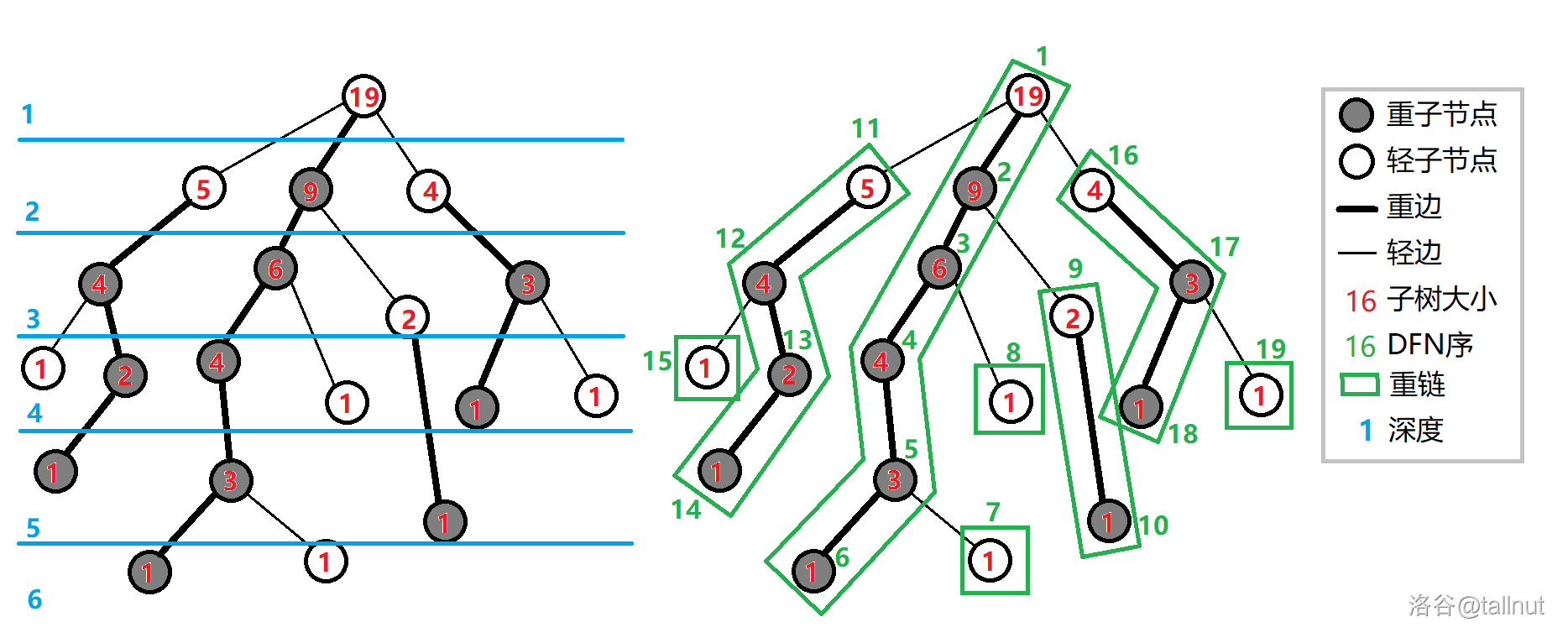
预处理部分:预处理所有节点的父亲
fa、深度 dep、其子树大小 siz、重子节点 son、DFS 序 dfn、该节点所在重链的顶部 top,以及所有 DFS 序对应的节点编号(即 dfn 的反函数,因为 dfn 是单射)。这些都可以用两遍 DFS 求出来。可以发现,每向下走一条轻边,子树大小至少减半。因此树剖本身一次操作的时间复杂度为 ,当然这不算线段树等内部数据结构带来的 。
例题
P3384 【模板】重链剖分/树链剖分
模板题。考虑四个操作怎么做:
- 操作 :每次选择两个点的
top中深度较大的往上跳,这条链用线段树快速加。复杂度两只 。 - 操作 :与操作 类似,将修改换成查询即可。
- 操作 :观察到一个子树内 DFS 序必定连续。于是线段树修改即可,复杂度一只 。
- 操作 :类似操作 。
代码:
CPP#include <bits/stdc++.h>
using namespace std;
#define rep1(i,x,y) for (int i = (x);i <= (y);i++)
//CONSTANTS,VARIABLES
const int N = 1e5 + 10;
int n,q,r,mod,op,x,y,z,cnt;
int w[N],dep[N],siz[N],son[N],fa[N],top[N],dfn[N],wn[N];
vector<int> graph[N];
//树剖预处理DFS
void dfs1(int p,int faa)
{
dep[p] = dep[faa] + 1;
siz[p] = 1;
fa[p] = faa;
for (auto j : graph[p])
if (j != faa)
{
dfs1(j,p);
siz[p] += siz[j];
if (siz[j] > siz[son[p]])
son[p] = j;
}
}
void dfs2(int p,int faa)
{
if (p == son[faa])
top[p] = top[faa];
else
top[p] = p;
dfn[p] = ++cnt;
wn[cnt] = w[p];
if (son[p] == 0)
return;
dfs2(son[p],p);
for (auto j : graph[p])
if (j != faa && j != son[p])
dfs2(j,p);
}
//SEGTREE
struct node
{
int l;
int r;
int x;
int lazy;
} t[N << 2];
inline int ls(int p) { return p << 1; }
inline int rs(int p) { return p << 1 | 1; }
inline void push_up(int p) { t[p].x = (t[ls(p)].x + t[rs(p)].x) % mod; }
void push_down(int p)
{
t[ls(p)].lazy += t[p].lazy;
t[rs(p)].lazy += t[p].lazy;
t[ls(p)].x = (t[ls(p)].x + 1ll * t[p].lazy * (t[ls(p)].r - t[ls(p)].l + 1)) % mod;
t[rs(p)].x = (t[rs(p)].x + 1ll * t[p].lazy * (t[rs(p)].r - t[rs(p)].l + 1)) % mod;
t[p].lazy = 0;
}
void build(int p,int l,int r)
{
t[p].l = l;
t[p].r = r;
if (l == r)
{
t[p].x = wn[l] % mod;
return;
}
int mid = (l + r) >> 1;
build(ls(p),l,mid);
build(rs(p),mid + 1,r);
push_up(p);
}
void modify(int p,int l,int r,int k)
{
if (l <= t[p].l && t[p].r <= r)
{
t[p].lazy += k;
t[p].x += (t[p].r - t[p].l + 1) * k;
return;
}
push_down(p);
int mid = (t[p].l + t[p].r) >> 1;
if (l <= mid)
modify(ls(p),l,r,k);
if (r > mid)
modify(rs(p),l,r,k);
push_up(p);
}
int query(int p,int l,int r)
{
if (l <= t[p].l && t[p].r <= r)
return t[p].x % mod;
push_down(p);
int mid = (t[p].l + t[p].r) >> 1;
int ans = 0;
if (l <= mid)
ans = (ans + query(ls(p),l,r)) % mod;
if (r > mid)
ans = (ans + query(rs(p),l,r)) % mod;
return ans;
}
//树剖操作
void modify1(int u,int v,int k)
{
k %= mod;
int ans = 0;
while (top[u] != top[v])
{
if (dep[top[u]] < dep[top[v]])
swap(u,v);
modify(1,dfn[top[u]],dfn[u],k);
u = fa[top[u]];
}
if (dep[u] < dep[v])
swap(u,v);
modify(1,dfn[v],dfn[u],k);
}
int query1(int u,int v)
{
int ans = 0;
while (top[u] != top[v])
{
if (dep[top[u]] < dep[top[v]])
swap(u,v);
ans = (ans + query(1,dfn[top[u]],dfn[u])) % mod;
u = fa[top[u]];
}
if (dep[u] < dep[v])
swap(u,v);
ans = (ans + query(1,dfn[v],dfn[u])) % mod;
return ans;
}
void modify2(int p,int k) { modify(1,dfn[p],dfn[p] + siz[p] - 1,k % mod); }
int query2(int p) { return query(1,dfn[p],dfn[p] + siz[p] - 1); }
//MAIN
int main()
{
cin >> n >> q >> r >> mod;
rep1(i,1,n)
cin >> w[i];
rep1(i,1,n - 1)
{
cin >> x >> y;
graph[x].push_back(y);
graph[y].push_back(x);
}
dfs1(r,0);
dfs2(r,0);
build(1,1,n);
while (q--)
{
cin >> op >> x;
switch (op)
{
case 1:
cin >> y >> z;
modify1(x,y,z);
break;
case 2:
cin >> y;
cout << query1(x,y) << '\n';
break;
case 3:
cin >> y;
modify2(x,y);
break;
case 4:
cout << query2(x) << '\n';
break;
}
}
}
P3979 遥远的国度
感谢 @zhikang 教会我代码实现细节,orz。
一开始按照 为根 DFS。
前两个操作是树剖板子,用区间覆盖、区间查 即可。
第三种需要分类讨论。设换成的根为 ,原树根为 :
- 如果 :显然是对 整棵树进行查询。
- 否则,令 :
- :查询的就是这棵子树本身;
- 否则,在整棵树中抠掉这棵子树,对剩余部分进行查询。
以上内容画个图很好理解。
代码:
CPP#include <bits/stdc++.h>
#define rep1(i,x,y) for (int i = (x);i <= (y);i++)
#define rep2(i,x,y) for (int i = (x);i >= (y);i--)
#define int long long
using namespace std;
const int N = 2e5 + 10;
int n,q,op,u,v,x,y,z,cnt,rt;
int a[N],siz[N],dep[N],son[N],top[N],dfn[N],rk[N],fa[N],ffa[20][N];
vector<int> graph[N];
#define mid ((t[p].l + t[p].r) >> 1)
class segtree
{
struct node
{
int l;
int r;
int mn;
int lazy;
} t[N << 2];
inline int ls(int p) { return p << 1; }
inline int rs(int p) { return p << 1 | 1; }
inline void push_up(int p) { t[p].mn = min(t[ls(p)].mn,t[rs(p)].mn); }
void push_down(int p)
{
if (t[p].lazy)
{
t[ls(p)].mn = t[p].lazy;
t[rs(p)].mn = t[p].lazy;
t[ls(p)].lazy = t[p].lazy;
t[rs(p)].lazy = t[p].lazy;
t[p].lazy = 0;
}
}
void build_p(int p,int l,int r,int a[])
{
t[p].l = l;
t[p].r = r;
if (l == r)
{
t[p].mn = a[rk[l]];
return;
}
build_p(ls(p),l,mid,a);
build_p(rs(p),mid + 1,r,a);
push_up(p);
}
int query_p(int p,int l,int r)
{
if (l <= t[p].l && t[p].r <= r)
return t[p].mn;
push_down(p);
int ans = 2e9;
if (l <= mid)
ans = min(ans,query_p(ls(p),l,r));
if (r > mid)
ans = min(ans,query_p(rs(p),l,r));
return ans;
}
void modify_p(int p,int l,int r,int k)
{
if (l <= t[p].l && t[p].r <= r)
{
t[p].mn = k;
t[p].lazy = k;
return;
}
push_down(p);
if (l <= mid)
modify_p(ls(p),l,r,k);
if (r > mid)
modify_p(rs(p),l,r,k);
push_up(p);
}
public:
segtree() { memset(t,0,sizeof t); }
void build(int n,int a[]) { build_p(1,1,n,a); }
int query(int l,int r) { return query_p(1,l,r); }
void modify(int l,int r,int k) { modify_p(1,l,r,k); }
} t;
#undef mid
void dfs1(int p,int faa)
{
siz[p] = 1;
fa[p] = faa;
ffa[0][p] = faa;
rep1(i,1,19)
ffa[i][p] = ffa[i - 1][ffa[i - 1][p]];
dep[p] = dep[faa] + 1;
for (auto j : graph[p])
if (j != faa)
{
dfs1(j,p);
siz[p] += siz[j];
if (siz[j] > siz[son[p]])
son[p] = j;
}
}
void dfs2(int p,int faa)
{
if (p == son[faa])
top[p] = top[faa];
else
top[p] = p;
dfn[p] = ++cnt;
rk[cnt] = p;
if (son[p] == 0)
return;
dfs2(son[p],p);
for (auto j : graph[p])
if (j != faa && j != son[p])
dfs2(j,p);
}
int jump(int p,int step)
{
rep2(i,19,0)
if ((1 << i) <= step)
{
p = ffa[i][p];
step -= (1 << i);
}
return p;
}
int lca(int x,int y)
{
while (top[x] != top[y])
{
if (dep[top[x]] > dep[top[y]])
x = fa[top[x]];
else
y = fa[top[y]];
}
if (dep[x] < dep[y])
return x;
else
return y;
}
void modify(int x,int y,int k)
{
while (top[x] != top[y])
{
if (dep[top[x]] > dep[top[y]])
{
t.modify(dfn[top[x]],dfn[x],k);
x = fa[top[x]];
}
else
{
t.modify(dfn[top[y]],dfn[y],k);
y = fa[top[y]];
}
}
if (dfn[x] < dfn[y])
t.modify(dfn[x],dfn[y],k);
else
t.modify(dfn[y],dfn[x],k);
}
int qquery(int x)
{
int lcaa = lca(x,rt);
if (lcaa != x)
return t.query(dfn[x],dfn[x] + siz[x] - 1);
if (x != rt)
{
int tt = jump(rt,dep[rt] - dep[x] - 1);
int ans1 = 2e9;
int ans2 = 2e9;
if (dfn[tt] > 1)
ans1 = t.query(1,dfn[tt] - 1);
if (dfn[tt] + siz[tt] <= n)
ans2 = t.query(dfn[tt] + siz[tt],n);
return min(ans1,ans2);
}
return t.query(1,n);
}
signed main()
{
ios::sync_with_stdio(false);
cin.tie(0);
cout.tie(0);
cin >> n >> q;
rep1(i,1,n - 1)
{
cin >> u >> v;
graph[u].push_back(v);
graph[v].push_back(u);
}
rep1(i,1,n)
cin >> a[i];
cin >> rt;
dfs1(1,0);
dfs2(1,0);
t.build(n,a);
while (q--)
{
cin >> op >> x;
switch (op)
{
case 1:
rt = x;
break;
case 2:
cin >> y >> z;
modify(x,y,z);
break;
case 3:
cout << qquery(x) << '\n';
break;
}
}
}
相关推荐
评论
共 8 条评论,欢迎与作者交流。
正在加载评论...